MarketAMSTERDAM · Event November 9, 2026
Argenx to buy macrocyclic peptide biotech Unnatural Products
The deal moves an antibody company into macrocyclic peptides, a class being developed as oral drugs. Unnatural Products has disclosed no clinical-stage drug, and the deal has not closed.
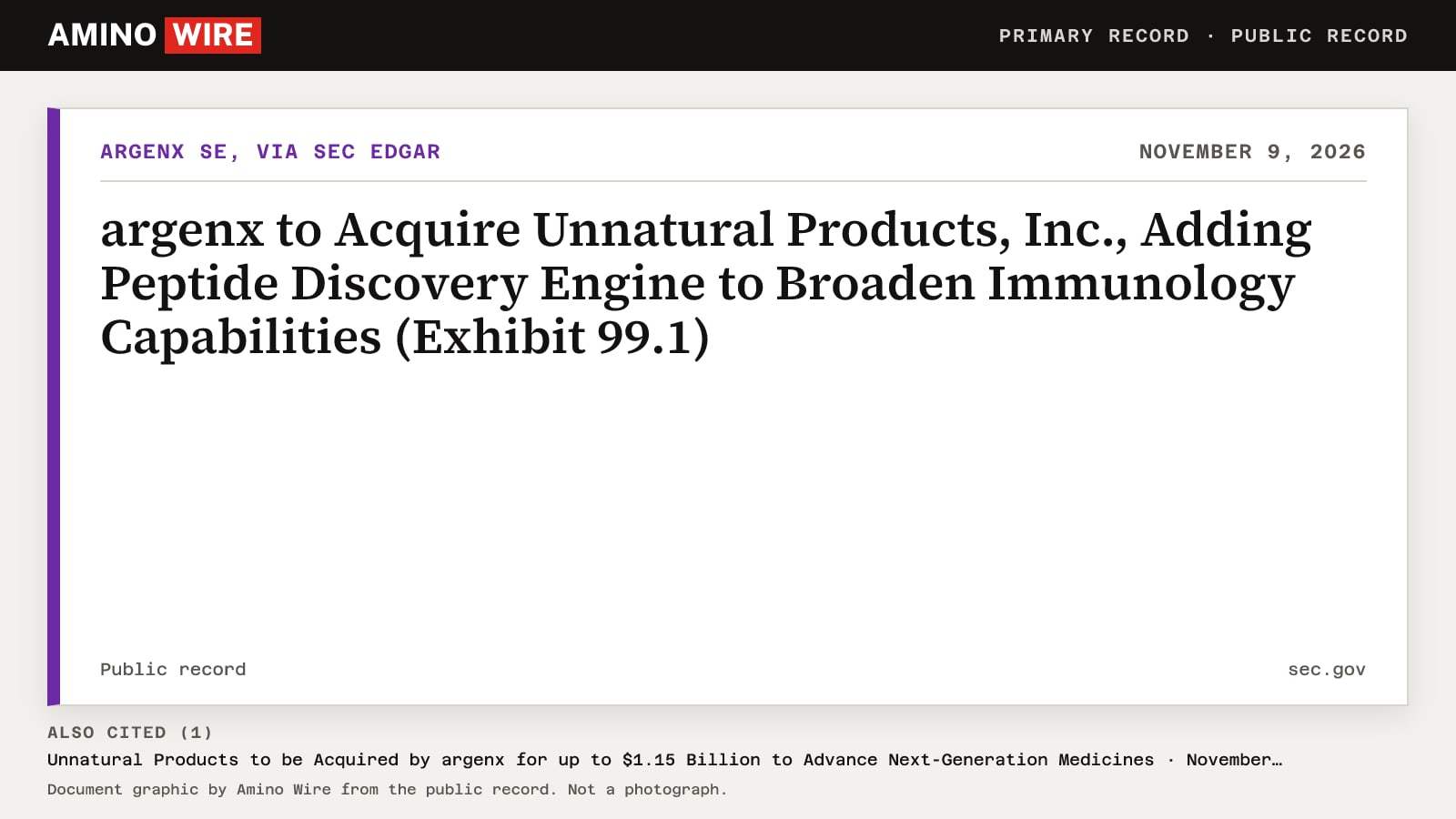
Argenx, the Amsterdam-based immunology company best known for the antibody fragment Vyvgart, has agreed to buy Unnatural Products (UNP), a privately held California biotech that designs macrocyclic peptides. The deal, announced on November 9, 2026, is the second large bet on ring-shaped oral peptides by a major drugmaker in less than three weeks.
According to argenx’s announcement, filed with the SEC, argenx will pay $550 million upfront from cash on hand. It will also pay up to $595 million more if specified development and regulatory milestones are reached, putting the total potential value at up to approximately $1.15 billion. Argenx already owned a minority stake in UNP and is buying the remaining shares. Both boards have approved the transaction, and argenx expects it to close by the end of the year, subject to customary conditions.
What argenx is buying
UNP does not have a disclosed drug in clinical testing. What argenx is acquiring is a discovery engine. In its own release, UNP says it spent 10 years building a platform that combines AI-guided design with massively parallel synthesis and direct-to-biology screening. The goal is to make drug-like macrocycles against targets that ordinary small molecules and antibodies struggle to reach, including targets inside cells.
Macrocyclic peptides are amino acid chains closed into a ring. Most peptide drugs today are injected because the gut breaks them down. A ring structure can make a peptide sturdier and, in some cases, able to work as a pill. Fierce Biotech pointed to Johnson & Johnson’s Icotyde and Merck’s Lipfendra as examples of oral delivery with this class.
UNP was founded in 2016 by Cameron Pye, now its CEO, and Joshua Schwochert, its chief scientific officer, while they were finishing doctoral work at the University of California, Santa Cruz. After the deal closes, the team will keep working from Santa Cruz, which argenx says will be its “home for peptide discovery.” UNP will keep leading discovery “within a strategic framework agreed upon with argenx,” while argenx handles clinical development and commercialization.
Argenx CEO Karen Massey said UNP “adds macrocyclic peptide capabilities that are highly complementary to our antibody engineering and creates new possibilities for oral and long-acting medicines.”
A crowded partner list
UNP says it also has partnerships with Novartis, Merck, and BridgeBio. BioSpace reported that the original argenx collaboration, announced in July 2025, carried $1.5 billion in potential milestones, and that UNP raised $45 million in a Series B round in March with argenx and Merck’s venture arm taking part. Neither company said what happens to the other partnerships after the acquisition.
Why it matters
Argenx’s main business is antibodies given by infusion or injection. Buying a peptide platform signals that it wants oral or longer-acting options for immune-mediated diseases. The deal follows Gilead’s agreement in October to buy an oral macrocyclic IL-23 receptor program from PepStar Therapeutics, and comes as J&J’s Icotyde, an oral IL-23 receptor peptide, reaches more markets. Taken together, large companies are paying for the ability to make peptides into pills, not only for individual drugs.
What is not known
- Which diseases or targets argenx will pursue first. Neither release names a program.
- What the milestones are. Argenx described them only as specified development and regulatory milestones.
- How long it will take. No drug from the platform has been shown to work or be tolerable in people, and peptide discovery programs typically take years to reach patients.
- The fate of UNP’s other partnerships with Novartis, Merck, and BridgeBio.
We will update this story when the deal closes or argenx names its first peptide candidate.
What changed: key dates
Frequently asked questions
What is argenx paying for Unnatural Products?
Argenx says it will pay $550 million upfront in cash and up to $595 million in contingent payments tied to development and regulatory milestones, for a total of up to approximately $1.15 billion.
What are macrocyclic peptides?
They are peptides whose chain is closed into a ring. The ring shape can help a peptide resist breakdown in the gut and get into cells, which is why companies are studying them as possible oral drugs. Unnatural Products builds them with machine learning and large-scale parallel synthesis.
Does Unnatural Products have a drug in human trials?
Neither announcement names a clinical-stage drug or reports clinical results. The deal is for the discovery platform and team, according to both companies.
Sources
4 linked records- [1] argenx to Acquire Unnatural Products, Inc., Adding Peptide Discovery Engine to Broaden Immunology Capabilities (Exhibit 99.1)
argenx SE, via SEC EDGAR · Primary record
- [2] Unnatural Products to be Acquired by argenx for up to $1.15 Billion to Advance Next-Generation Medicines
Argenx to acquire UNP for $550 million upfront plus contingent value rights tied to development and regulatory milestones, for total potential value of up...
Unnatural Products, Inc., via GlobeNewswire · Primary record
- [3]
- [4]
Amino Wire reports regulatory and court records. Nothing here is medical or legal advice, and we do not provide dosing information. Named companies may respond; see right of reply.