MarketST. LOUIS · Event November 25, 2026
GLP-1 drugs linked to lower heart risk in serious mental illness
The observational Journal of the American Heart Association analysis compared GLP-1 users with matched non-users at one and three years; it does not show that the drugs caused the difference.
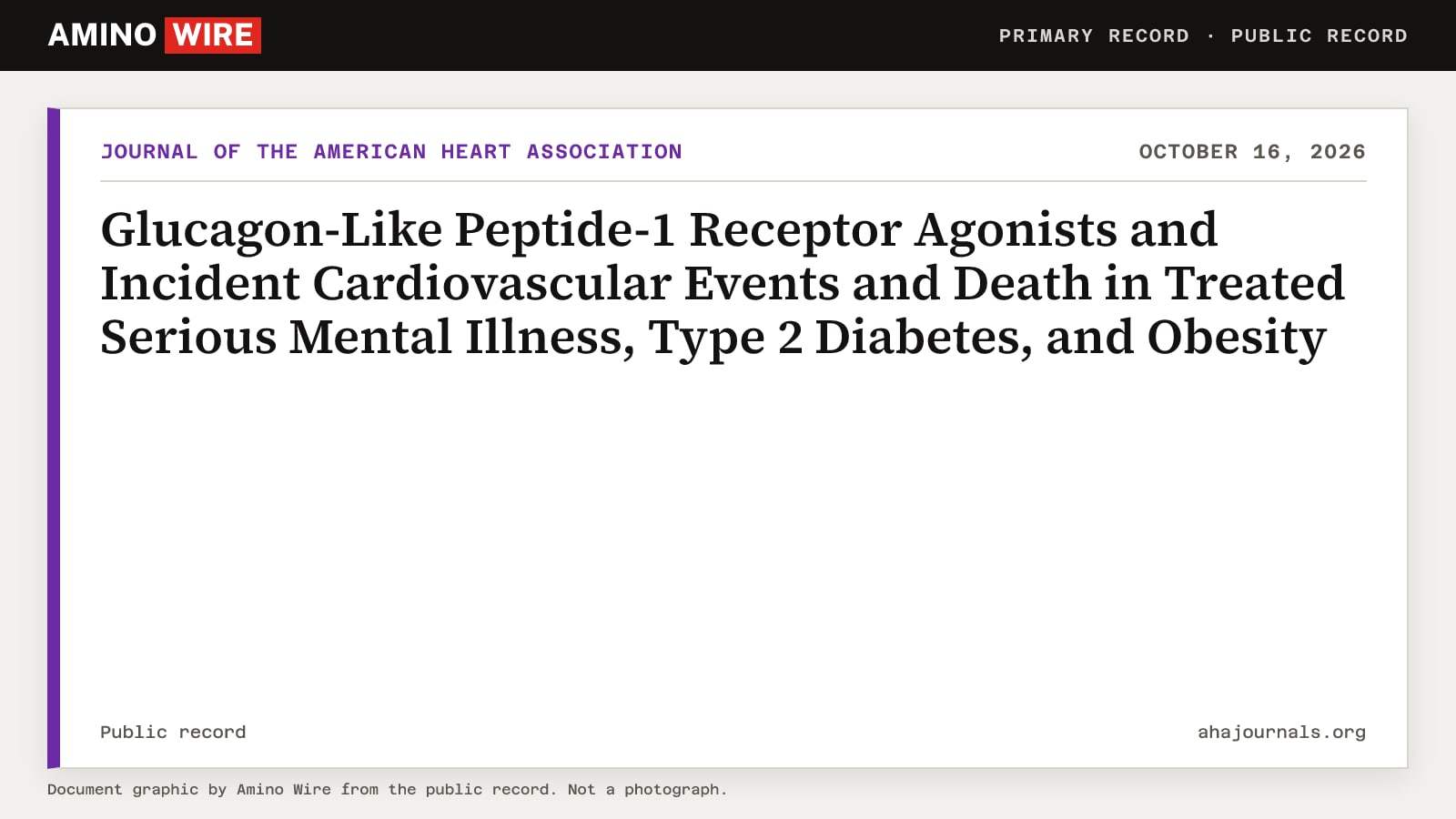
A retrospective study published online on Oct. 16, 2026, in the Journal of the American Heart Association linked use of GLP-1 receptor agonists to lower risks of incident heart attack, heart failure, and death from any cause among adults with treated serious mental illness, type 2 diabetes, and obesity. The paper does not establish that the medicines caused those differences.
The authors analyzed electronic health records of more than 218,000 adults in the TriNetX network, from 73 U.S. health care organizations. Everyone included had type 2 diabetes, obesity, at least two recorded diagnoses of a qualifying serious mental illness, and an active antipsychotic or antidepressant prescription. The primary comparison was GLP-1 use versus non-use after propensity-score matching, with outcomes measured at one and three years. Encounters in the data ran from December 2017 through December 2025.
Senior authors are Victor G. Dávila-Román, MD, a professor in the Cardiovascular Division at WashU Medicine, and Leopoldo J. Cabassa, PhD, a professor at the WashU Brown School. The first author is Samuel B. Governor, MD, MPH. The article is open access in JAHA (doi: 10.1161/JAHA.126.051982). Washington University posted a newsroom brief on the paper on Nov. 25; the Brown School had described the work on Oct. 27.
What the study found
The authors reported that GLP-1 use was associated with lower risks of incident myocardial infarction, heart failure, and all-cause death. Absolute risk differences at one and three years were -0.007 and -0.010 for heart attack, -0.011 and -0.018 for heart failure, and -0.039 and -0.065 for death, all P values below 0.001.
Secondary analyses of semaglutide or tirzepatide were also associated with lower risks of those outcomes, the paper said. Its conclusions referred to GLP-1 users, “particularly semaglutide or tirzepatide.” Washington University’s later brief said the strongest benefits were observed among users of those two medicines. The authors noted that they did not run those secondary analyses for other GLP-1 drugs.
What the study cannot show
This is observational research, not a randomized trial. “These pooled associations should be interpreted in the context of SMI’s clinical heterogeneity and the limitations of administrative case ascertainment,” the authors wrote. They also said unmeasured confounding remains possible, that the TriNetX records lack information on medication dose, adherence, and treatment-related adverse effects, and that findings should be read as an average association across a mixed group of serious mental illnesses rather than a uniform effect in each subgroup. People with serious mental illness have often been left out of large cardiovascular outcomes trials of GLP-1 medicines, the paper noted, which is why the authors turned to routinely collected records.
What is not known
The study cannot show whether starting a GLP-1 medicine caused the lower event rates, how results would look in a randomized trial of this population, or how the association varies across specific serious mental illness diagnoses. The records also did not capture medication dose, adherence, or treatment-related adverse effects.
What changed: key dates
Frequently asked questions
Did the study show that GLP-1 drugs prevent heart attacks?
No. It is a retrospective, observational comparison of users and matched non-users. The authors reported associations, not proof that the medicines caused the lower rates, and they noted that unmeasured confounding remains possible.
Who was included?
Adults with type 2 diabetes, obesity, at least two recorded diagnoses of a qualifying serious mental illness, and an active antipsychotic or antidepressant prescription, in electronic records from 73 U.S. health care organizations in the TriNetX network. Washington University and the paper describe a cohort of more than 218,000 adults.
When was the paper published?
It was published online on Oct. 16, 2026, and in print on Oct. 20, 2026, in the Journal of the American Heart Association. Washington University posted a later newsroom brief on Nov. 25.
Sources
3 linked records- [1] Glucagon-Like Peptide-1 Receptor Agonists and Incident Cardiovascular Events and Death in Treated Serious Mental Illness, Type 2 Diabetes, and Obesity
Journal of the American Heart Association · Primary record
- [2] GLP-1 drugs linked to lower cardiovascular risk in people with serious mental illness
Researchers at WashU Medicine and the Brown School found that GLP-1 medications including semaglutide and tirzepatide were associated with lower risks of heart attack, heart failure and death among adults with serious mental illness, type 2 diabetes and…
Washington University in St. Louis (The Source) ·
- [3] Study links GLP-1 drugs to lower heart risks in people with serious mental illness
GLP-1 medications, including semaglutide and tirzepatide, are associated with lower risks of heart attack, heart failure and death among adults with serious mental illness, Type 2 diabetes and obesity, according to a new study co-authored by Leopoldo J.…
WashU Brown School ·
Amino Wire reports regulatory and court records. Nothing here is medical or legal advice, and we do not provide dosing information. Named companies may respond; see right of reply.