RegulationCHICAGO · Event October 22, 2026
Two-thirds of Nebraska compounded tirzepatide carried B12
Cyanocobalamin appeared in 63.1% of tirzepatide prescriptions. Authors link formula shifts after FDA ended the tirzepatide shortage.
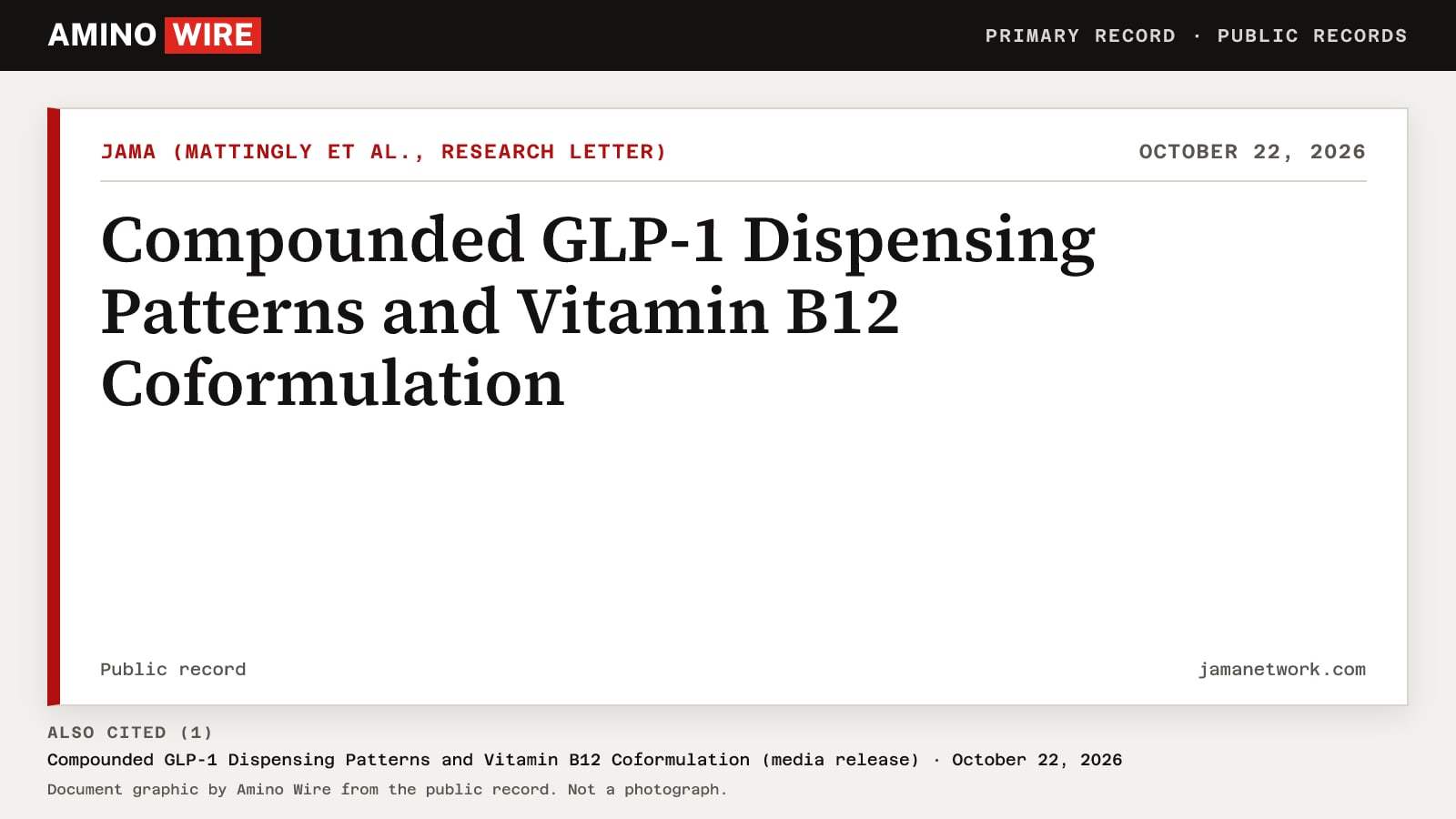
A JAMA research letter published online on October 22, 2026 maps how compounded weight-loss drugs moved through Nebraska — and how often those products were mixed with vitamin B12 and other additives that do not appear in FDA-approved GLP-1 medicines. The letter, by T. Joseph Mattingly II and Emeka Elvis Duru (University of Utah), Matthew L. Maciejewski (Duke University), and Rena M. Conti (Boston University), draws on Nebraska’s prescription drug monitoring program (PDMP) from January 2018 to April 2026. JAMA’s media release identifies the paper (doi:10.1001/jama.2026.21223); author affiliations also appear on the public first page of the JAMA listing. Detailed dispensing figures below come from Medscape Medical News’ October 29 report on the letter, which quotes the authors and summarizes the results; the JAMA full text returned HTTP 403 from our desk fetch, so we treat Medscape as the secondary source for the numbers and say so.
What the Nebraska data show
Medscape reports 13,964 compounded weight-loss prescriptions dispensed to 6,089 patients in the study window: semaglutide 40.1%, tirzepatide 36.6%, and phentermine 23.3%. Nearly all of them — 99.5% (13,888 prescriptions) — were recorded as private pay (cash, charge, or credit card) rather than Medicaid, Medicare, or commercial insurance. Mattingly told Medscape that near-universal cash payment “means this market sits almost entirely outside claims-based surveillance.”
Compounded GLP-1s were absent before 2024. Dispensing rose from 4,116 prescriptions in 2024 to 5,485 in 2025. In 2025, semaglutide and tirzepatide accounted for 86.4% of the 6,344 compounded weight-loss prescriptions that year.
Geography is the other hard edge. All 10,711 compounded GLP-1 prescriptions were filled by out-of-state pharmacies; none came from Nebraska pharmacies. Three pharmacies in Florida and Texas accounted for 69.8% of that volume, even though 42.8% of the prescriptions were written by Nebraska-based clinicians. Nurse practitioners and physician assistants wrote 70.7% of compounded GLP-1 prescriptions; physicians wrote 29%. Among 717 unique prescribers, the top 10 accounted for 36.4% of all compounded weight-loss prescriptions.
B12 coformulation — and a post-shortage mix shift
The letter’s headline finding for compounding oversight is the additive mix. Cyanocobalamin was present in 63.1% of tirzepatide prescriptions and 39.7% of semaglutide prescriptions. Two-thirds of tirzepatide prescriptions — 3,462, or 67.8% — contained at least one vitamin B12 analog (cyanocobalamin, methylcobalamin, or hydroxocobalamin).
The mix changed after FDA ended the tirzepatide shortage. Between 2024 and 2025, cyanocobalamin in tirzepatide prescriptions fell from 85% to 54.4%, while levocarnitine rose from 0.4% to 16.0%. Medscape quotes the authors’ suggestion that the concurrent decline in cyanocobalamin and rise in levocarnitine “coincides with the FDA’s December 2024 tirzepatide shortage resolution and may reflect compounder efforts to formulate products argued to be clinically distinct from approved tirzepatide.” Amino Wire previously covered that shortage resolution (report) and the narrower grounds that remained for compounding after shortages ended (explainer).
The authors also note, via Medscape, that an earlier study found a tirzepatide-B12 adduct impurity in compounded tirzepatide/B12 products, and that comparable characterization has not been published for the other combinations seen in Nebraska.
Why it matters
Compounded GLP-1 combinations are not the approved brand products. After the shortage window closed, FDA has continued to press on mass marketing of compounded GLP-1s as substitutes (February 2026 statement). The Nebraska snapshot shows how large a cash-pay, out-of-state channel can be even in a single state that actually records compounded dispensing.
Mattingly told Medscape: “The risks are largely unknown, and that is the problem.” Medscape reports that the authors argue the pattern warrants mandatory testing and adverse-event reporting for mass-compounded combination drugs. He also told Medscape that voluntary FDA MedWatch reports are currently the only surveillance for these products.
What is not known
- Outcomes. PDMP records capture dispensing, not clinical results. Co-occurrence of ingredients on a prescription does not prove the chemical composition, potency, or stability of what a patient received.
- Route. Administration route was not recorded, so injectables could not be separated from oral formulations.
- Completeness even in Nebraska. Mattingly told Medscape that compounded products are inconsistently reported with appropriate identifiers, so the counts are “likely conservative.”
- National share. The letter is one state. Medscape says the authors write that the findings “mirror national online reviews and studies in Colorado, West Virginia, and Oklahoma,” but this letter does not itself re-analyze those other datasets.
- Full-text caveats. Our desk could not load the JAMA HTML (HTTP 403). Figures and quotes above are those Medscape attributed to the letter or to Mattingly; we have not independently re-tabulated the PDMP extract.
What to watch
Whether other states expand PDMP capture of compounded products; whether FDA or Congress moves on mandatory testing and adverse-event reporting for mass-compounded combinations; and whether the post-shortage shift toward additives marketed as making a product “clinically distinct” continues in 2026 dispensing data. Clinicians, the authors warn (via Medscape), should not assume a patient who reports taking tirzepatide or semaglutide is on an FDA-approved product.
What changed: key dates
| Date | What happened |
|---|---|
| JAMA (Mattingly et al., research letter): Compounded GLP-1 Dispensing Patterns and Vitamin B12 Coformulation | |
| JAMA Network (American Medical Association): Compounded GLP-1 Dispensing Patterns and Vitamin B12 Coformulation (media release) | |
| Event date for this report | |
| Medscape Medical News (Marilynn Larkin): Compounded GLP-1s Widely Coformulated With Vitamin B12 and Other Additives | |
| Amino Wire published this report |
Frequently asked questions
What share of compounded tirzepatide in Nebraska carried vitamin B12?
Medscape's report of the JAMA letter says 67.8% of compounded tirzepatide prescriptions (3,462) contained at least one vitamin B12 analog. Cyanocobalamin alone was in 63.1% of tirzepatide prescriptions and 39.7% of semaglutide prescriptions.
Where were the compounded GLP-1s dispensed?
All 10,711 compounded GLP-1 prescriptions in the Nebraska PDMP window were dispensed by out-of-state pharmacies. Three pharmacies in Florida and Texas accounted for 69.8%. About 42.8% of the prescriptions were written by Nebraska-based prescribers.
Who paid for these prescriptions?
Medscape reports that 99.5% (13,888 of 13,964) of compounded weight-loss prescriptions were recorded as private pay (cash, charge, or credit card) rather than Medicaid, Medicare, or commercial insurance.
Sources
3 linked records- [1] Compounded GLP-1 Dispensing Patterns and Vitamin B12 Coformulation
JAMA (Mattingly et al., research letter) · Primary record
- [2] Compounded GLP-1 Dispensing Patterns and Vitamin B12 Coformulation (media release)
JAMA Network (American Medical Association) · Primary record
- [3] Compounded GLP-1s Widely Coformulated With Vitamin B12 and Other Additives
Medscape Medical News (Marilynn Larkin) ·
Amino Wire reports regulatory and court records. Nothing here is medical or legal advice, and we do not provide dosing information. Named companies may respond; see right of reply.