MarketDENVER · Event November 8, 2026
Novo drugs cut fibrosis markers in alcohol-related liver disease
Mayo Clinic's Vijay Shah presented abstract 0087 in Denver. Drinking fell in every group but not significantly more than on placebo, which investigators read as a possible direct liver effect.
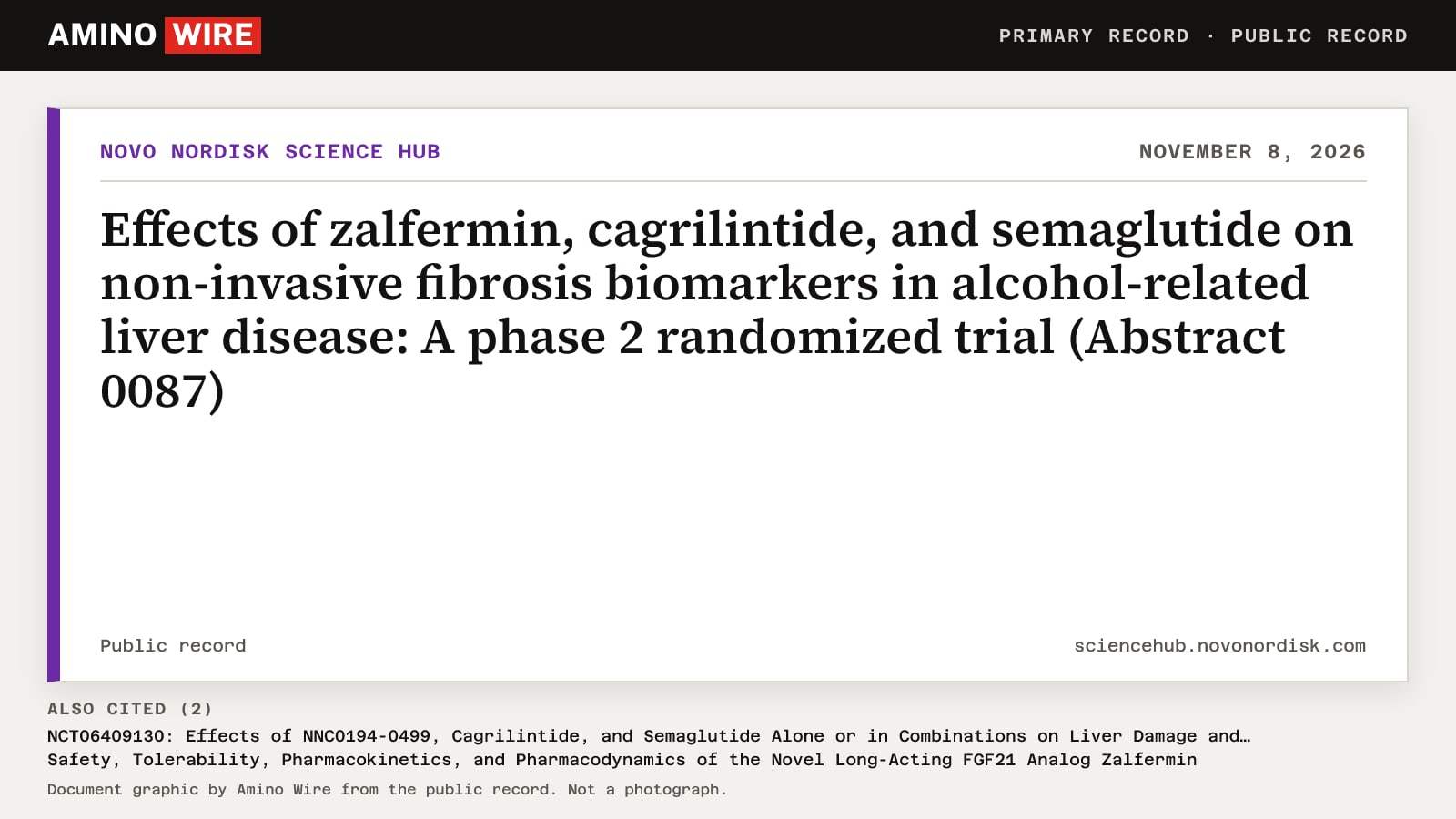
Three Novo Nordisk drugs developed for obesity and fatty liver disease each lowered a blood-based liver fibrosis score compared with placebo in heavy drinkers with alcohol-related liver disease, according to Phase 2 results presented on November 8, 2026 at The Liver Meeting 2026, the annual meeting of the American Association for the Study of Liver Diseases (AASLD) in Denver.
Vijay Shah, MD, of the Division of Gastroenterology and Hepatology at Mayo Clinic in Rochester, Minnesota, presented the trial as abstract 0087 in an 11:00 a.m. Mountain time slot. The trial title and Novo’s abstract use the term “alcohol-related liver disease”; AASLD’s session title uses “alcohol-associated liver disease.” Both refer to the same condition, and this story uses the trial’s wording.
The trial
The multinational, placebo-controlled study randomized 270 people with heavy alcohol use and advanced liver disease, HCPLive reported. ClinicalTrials.gov lists the Novo Nordisk-sponsored study as NCT06409130, completed, with an actual enrollment of 270.
Participants received 28 weeks of a once-weekly injection of one of three drugs or one of two combinations:
- Zalfermin, coded NNC0194-0499 in the trial registry, an analog of the hormone FGF21
- Cagrilintide, an amylin analog
- Semaglutide, the GLP-1 receptor agonist also sold as Wegovy
- Zalfermin plus semaglutide
- Cagrilintide plus semaglutide, the pairing Novo calls CagriSema
The registry splits the study into two groups, each with its own matched placebo: one testing zalfermin and semaglutide, and one testing cagrilintide and CagriSema. A published first-in-human study identifies zalfermin as the drug “formerly NNC0194-0499.”
What was reported
The primary endpoint was the change in the Enhanced Liver Fibrosis (ELF) score, a blood test that estimates scarring, from week 0 to week 28. HCPLive reported that every active treatment arm met it, lowering ELF scores compared with placebo. Liver stiffness and PRO-C3, a blood marker tied to collagen formation, also improved consistently.
The investigators describe the study as the first randomized trial to show that drug treatment can improve fibrosis biomarkers in this disease, according to HCPLive.
Drinking fell in every group, including placebo, but the drug arms did not differ significantly from placebo. HCPLive says that pattern suggests the benefit may come in part from direct effects on the liver. Shah also pointed to metabolic risk factors in many participants, consistent with what clinicians call MetALD, as a possible contributor.
“If you took a liver of somebody who had MASLD or MASH and somebody who had alcohol, they looked the same,” Shah told HCPLive, explaining why drugs studied in fatty liver disease were tested here.
No drug is approved to target fibrosis in alcohol-related liver disease, and sustained abstinence remains the cornerstone of care, HCPLive noted. Zalfermin and cagrilintide are investigational, and none of the three drugs is approved for this use.
What is not known
- Effect sizes. No ELF changes, differences from placebo, liver stiffness values or p-values have been published in the public sources. It is not known which arm did best, or whether the combinations beat single drugs.
- Safety. Shah discussed safety and tolerability in a video interview, but no detailed adverse event data are public in the written sources.
- Durability and outcomes. ELF, liver stiffness and PRO-C3 are surrogate markers. A 28-week trial cannot show whether the drugs prevent cirrhosis, liver failure or death.
- Next steps. We found no Novo Nordisk press release on these results, and Novo has not said publicly whether it will run a larger trial.
This story summarizes a conference presentation and trial records. It is not medical advice.
What changed: key dates
| Date | What happened |
|---|---|
| HCPLive: MASH Therapies Show Fibrosis Signal in ALD, With Vijay Shah, MD | |
| Novo Nordisk Science Hub: Effects of zalfermin, cagrilintide, and semaglutide on non-invasive fibrosis biomarkers in alcohol-related liver disease: A phase 2 randomized trial (Abstract 0087) | |
| AASLD, The Liver Meeting 2026: Emerging and Repurposed Therapeutics in Alcohol-Associated Liver Disease (session, Nov 8) | |
| Event date for this report | |
| Amino Wire published this report |
Frequently asked questions
What is zalfermin?
Zalfermin, formerly coded NNC0194-0499, is Novo Nordisk's long-acting analog of the hormone FGF21. It is investigational and not approved for any use.
What is the ELF score?
The Enhanced Liver Fibrosis score is a blood test that estimates liver scarring without a biopsy. A change in ELF score from week 0 to week 28 was the trial's primary endpoint, according to ClinicalTrials.gov.
Is any drug approved to treat fibrosis in alcohol-related liver disease?
No. HCPLive notes that no approved therapies target the underlying fibrogenic process and that sustained abstinence remains the cornerstone of care.
Sources
5 linked records- [1]
- [2] Effects of zalfermin, cagrilintide, and semaglutide on non-invasive fibrosis biomarkers in alcohol-related liver disease: A phase 2 randomized trial (Abstract 0087)
Novo Nordisk Science Hub · Primary record
- [3] Emerging and Repurposed Therapeutics in Alcohol-Associated Liver Disease (session, Nov 8)
AASLD, The Liver Meeting 2026 ·
- [4] NCT06409130: Effects of NNC0194-0499, Cagrilintide, and Semaglutide Alone or in Combinations on Liver Damage and Alcohol Use in People With Alcohol-related Liver Disease
ClinicalTrials.gov (sponsor: Novo Nordisk A/S) Primary record
- [5] Safety, Tolerability, Pharmacokinetics, and Pharmacodynamics of the Novel Long-Acting FGF21 Analog Zalfermin
This first‐in‐human study investigated the safety, pharmacokinetics, and pharmacodynamics of the long‐acting fibroblast growth factor 21 (FGF21) analog zalfermin. Healthy male participants (n = 56) with body mass index 25.0–34.9 kg/m2 were ...
PubMed Central Primary record
Image: PubMed Central (PMC) (og:image from pmc.ncbi.nlm.nih.gov)

Amino Wire reports regulatory and court records. Nothing here is medical or legal advice, and we do not provide dosing information. Named companies may respond; see right of reply.