MarketROCHESTER · Event November 8, 2026
CAMEO-SEMA: semaglutide lowered exercise filling pressure
Among 81 patients, the estimated between-group difference in mean change in exercise PAWP was −10.6 mmHg. Hemodynamic remission was 53.7% with semaglutide versus 7.4% with placebo, with a wide confidence interval.
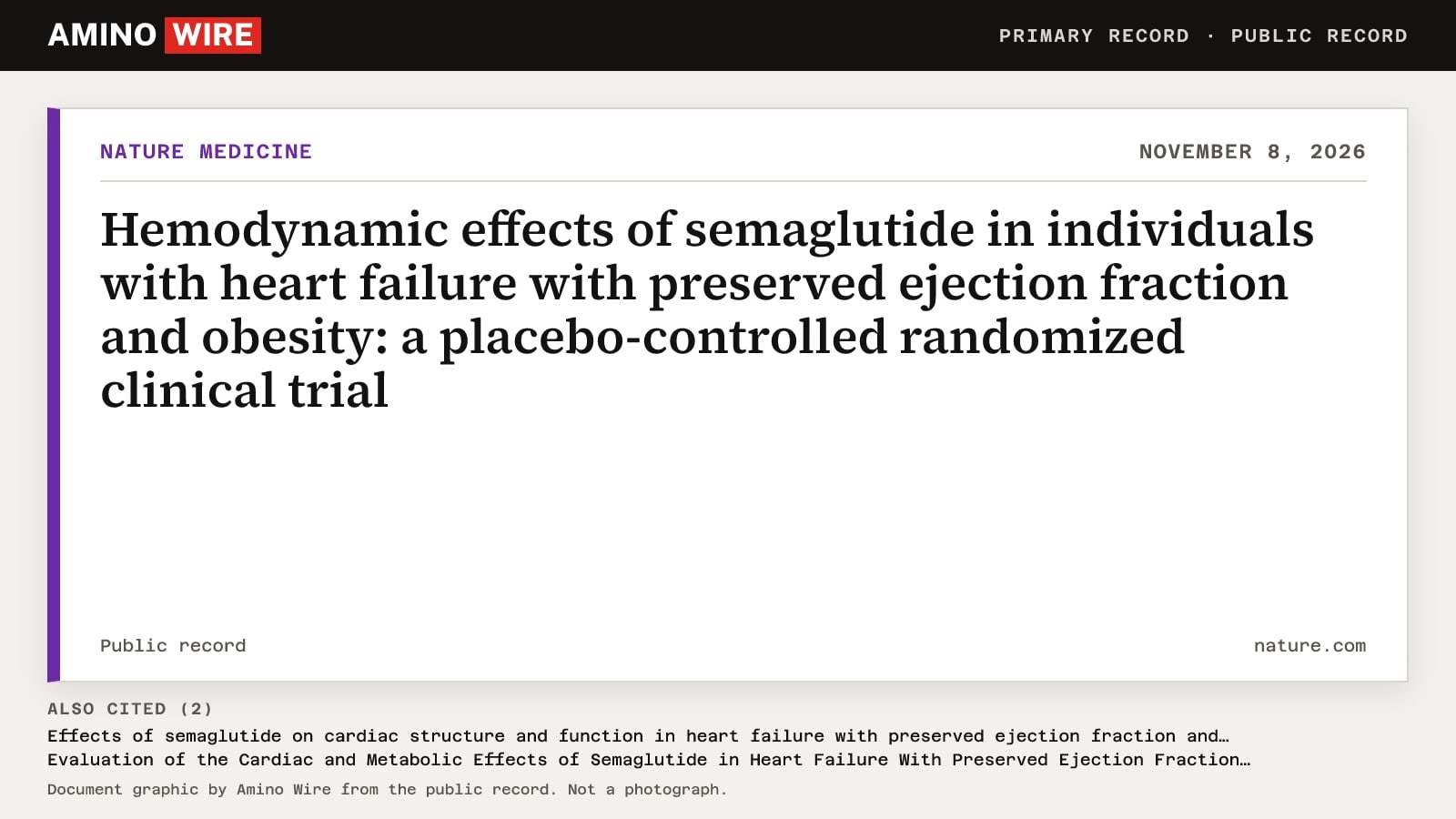
A double-blind, placebo-controlled trial at Mayo Clinic found that semaglutide reduced invasively measured left-heart filling pressure during exercise in people with heart failure with preserved ejection fraction (HFpEF) and obesity, and that just over half of patients assigned to the drug met a hemodynamic definition of remission at 52 weeks. The results, from Barry A. Borlaug, Milton Packer, and colleagues, were published in Nature Medicine on Nov. 8, 2026. A companion cardiac MRI substudy, also dated Nov. 8, reports related changes in atrial strain and ventricular filling. The papers and the ClinicalTrials.gov record identify the program as CAMEO-SEMA (NCT05371496).
Design
The main paper describes a double-blind trial that randomly assigned 81 patients (47 women) with HFpEF and obesity to “semaglutide (2.4 mg weekly) or placebo for 52 weeks.” The primary outcome was the change in pulmonary artery wedge pressure (PAWP), measured invasively, during low-intensity exercise. Extended-data captions in the same article identify that exercise workload as 20 watts and describe hemodynamic remission as a normal PAWP at both rest and exercise, specified as resting PAWP under 15 mmHg and exercise PAWP under 25 mmHg at week 52.
The ClinicalTrials.gov record, last updated Aug. 14, 2026, lists the study as Phase 4, sponsored by Mayo Clinic, with the U.S. Department of Defense as a collaborator, and names a single site: Mayo Clinic in Rochester, Minnesota. It records actual enrollment of 81 and an actual completion date of July 17, 2026. Both arms, according to that registry, also received counseling on a healthy lifestyle intervention. That counseling detail is not stated in the published abstracts we retrieved, so it is attributed to the registry.
Hemodynamic results
At baseline, mean PAWP in the trial cohort was 17.5 ± 4.3 mmHg at rest and 31.7 ± 5.2 mmHg during exercise. After 52 weeks, the mean change in exercise PAWP was −9.8 mmHg (95% CI −11.3 to −8.2) with semaglutide and +0.9 mmHg (95% CI −1.3 to 3.0) with placebo. The estimated between-group difference was −10.6 mmHg (95% CI −13.3 to −8.0, P less than 0.0001). Those figures are the primary analysis as reported in the abstract.
The estimated between-group difference in resting PAWP was −7.1 mmHg (95% CI −9.8 to −4.4, P less than 0.0001). Hemodynamic remission occurred in 53.7% of patients assigned to semaglutide versus 7.4% assigned to placebo (odds ratio 14.1, 95% CI 3.0 to 134.6, P less than 0.001). The confidence interval around that odds ratio is very wide. An extended-data note says a complete-case look at 70 participants with a usable 52-week 20-watt PAWP measurement (47 on semaglutide, 23 on placebo) uses a different denominator from the randomized-denominator remission analysis.
Cardiac MRI substudy
The companion paper is a prespecified cardiovascular magnetic resonance substudy of CAMEO-SEMA. Forty-nine participants (33 semaglutide, 16 placebo, 28 female) had MRI at baseline and at 52 weeks, within one day of the invasive exercise test. The prespecified primary imaging endpoint was the change in left atrial reservoir strain. Compared with placebo, the estimated difference was +5.7% (95% CI +0.3 to +9.7, P=0.037). Early filling rate indexed to end-diastolic volume (eFR/EDV) improved by +0.64 s−1 (95% CI +0.42 to +1.00, P less than 0.0001). The authors reported that those improvements were associated with reductions in exercise PAWP (r=−0.46, P less than 0.001, and r=−0.65, P less than 0.0001, respectively). They also wrote that semaglutide reduced left-ventricular mass, restored more physiologic left-ventricular geometry, and improved right-ventricular function and biventricular myocardial mechanics. The substudy abstract does not give separate numerical estimates for those last findings.
Funding and competing interests
The main paper says the work was supported by the Congressionally Directed Medical Research Programs under award W81XWH2210245, and that “Semaglutide and matching placebo were supplied by Novo Nordisk.” It also notes additional support for Borlaug from the National Heart, Lung, and Blood Institute, the Defense Department, and the Schoen Foundation. In the competing-interests statement, Borlaug reports research grant funding from Novo Nordisk, among other companies, and consulting for Novo Nordisk and Eli Lilly and Company, among others. The paper states: “The other authors declare no competing interests.”
What is not known
This is a small, single-site trial whose primary endpoint is a filling-pressure measurement, not hospitalizations or deaths. The remission odds ratio is imprecise. We were able to retrieve the abstracts, funding and conflict statements, and extended-data captions, but not the full discussion sections of either closed-access paper, so we cannot confirm every limitation the authors may have listed there. The results also do not, on their own, establish what happens after 52 weeks, or in a broader, multicenter population.
What changed: key dates
Frequently asked questions
What is CAMEO-SEMA?
CAMEO-SEMA is the registered name of a Mayo Clinic trial (NCT05371496) testing semaglutide in people with heart failure with preserved ejection fraction and obesity. The hemodynamic results and a cardiac MRI substudy were published in Nature Medicine on Nov. 8, 2026. ClinicalTrials.gov lists it as a Phase 4, double-blind, placebo-controlled study sponsored by Mayo Clinic, with the U.S. Department of Defense as a collaborator, at a single site in Rochester, Minnesota.
What does hemodynamic remission mean here?
The main paper defines hemodynamic HFpEF remission as a normal pulmonary artery wedge pressure both at rest and during exercise at 52 weeks. An extended-data caption specifies resting PAWP under 15 mmHg and exercise PAWP under 25 mmHg. In the randomized-denominator analysis reported in the abstract, that occurred in 53.7% of the semaglutide group and 7.4% of the placebo group. The 95% confidence interval around the odds ratio is very wide (3.0 to 134.6).
Did the trial measure hospitalizations or deaths?
The published primary outcome is a change in invasively measured exercise filling pressure, not hospital admissions or deaths. The papers we could retrieve do not present those clinical events as the main result.
Sources
3 linked records- [1]
- [2]
- [3] Evaluation of the Cardiac and Metabolic Effects of Semaglutide in Heart Failure With Preserved Ejection Fraction (CAMEO-SEMA), NCT05371496
ClinicalTrials.gov · Primary record
Amino Wire reports regulatory and court records. Nothing here is medical or legal advice, and we do not provide dosing information. Named companies may respond; see right of reply.