MarketINDIANAPOLIS · Event November 9, 2026
Lilly's Foundayo cuts sleep apnea events in Phase 3
The 52-week program enrolled adults with moderate-to-severe OSA and a BMI of 27 or higher, with or without PAP therapy. Foundayo is approved in the U.S. for weight management, not for sleep apnea.
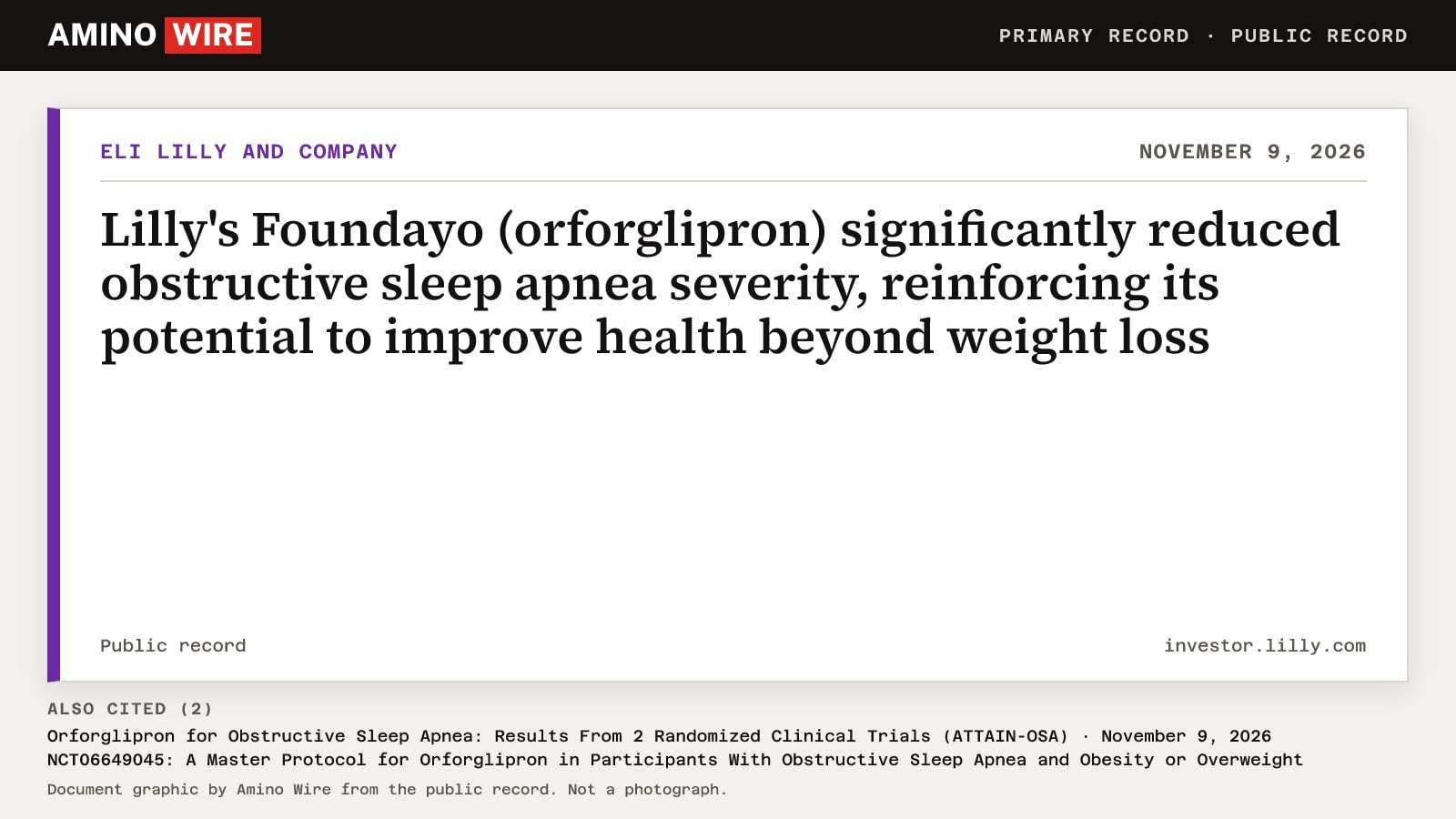
Eli Lilly said on November 9, 2026 that its daily oral drug Foundayo (orforglipron) reduced obstructive sleep apnea severity in two Phase 3 trials, and that it plans to ask the U.S. Food and Drug Administration to add that use by the end of the year. The ATTAIN-OSA results were presented at the American Heart Association Scientific Sessions 2026 in Chicago and published the same day in JAMA.
Foundayo is a once-daily small-molecule GLP-1 receptor agonist. Lilly describes it as a non-peptide pill. It is already approved in the United States for chronic weight management in adults with obesity, or in some adults with overweight who also have weight-related medical problems. It is not approved for sleep apnea. Lilly’s injectable Zepbound (tirzepatide) is already approved to improve moderate-to-severe OSA in adults with obesity.
The same day, FDA required a warning about a rare eye condition, NAION, on all GLP-1 receptor agonist labels, including Foundayo (report).
The two studies
ATTAIN-OSA (NCT06649045) is a master protocol of two 52-week, randomized, double-blind, placebo-controlled studies in adults with moderate-to-severe OSA and a body mass index of 27 or higher. Study 1 enrolled 363 people who were unable or unwilling to use positive airway pressure (PAP) therapy. Study 2 enrolled 349 people who had been on PAP for at least three months and continued it. ClinicalTrials.gov lists the program as completed, with actual enrollment of 712. The American Heart Association said participants did not have type 1 or type 2 diabetes.
People assigned to Foundayo were titrated to a maximum tolerated dose equivalent to the “9 mg”, “14.5 mg” or “17.2 mg” tablet strengths, according to the JAMA abstract.
Two ways of measuring the same trial
The two public write-ups lead with different estimands, so the AHI figures are not interchangeable.
Treatment-regimen estimand (JAMA’s primary analysis). This estimates the effect regardless of whether people stayed on treatment. In Study 1, AHI changed by -17.8 events per hour on Foundayo versus -4.5 on placebo, a difference of -13.2 (95% CI, -17.7 to -8.7). In Study 2, the changes were -17.3 versus -5.3, a difference of -12.0 (95% CI, -17.1 to -6.9). JAMA reported both comparisons as statistically significant. It said 6 of 7 key secondary endpoints were statistically significant in favor of Foundayo. The abstract does not say which secondary endpoint was not.
Efficacy estimand (Lilly’s release). Lilly’s numbers estimate the effect if participants had remained on treatment for 52 weeks without starting prohibited PAP, surgery or weight-management treatments. On that analysis, Study 1 AHI fell by -21.1 events per hour, or -43.8%, from a baseline of 50.7, versus -4.3, or -6.3%, on placebo. 47.2% of Foundayo participants had a 50% or greater AHI reduction, and 31.5% reached remission or mild OSA, which Lilly defined as AHI under 5, or AHI of 5 to under 15 without excessive daytime sleepiness. In Study 2, AHI fell by -18.3, or -27.5%, from a baseline of 57.6, versus -5.5, or -3.0%, on placebo; 33.7% had a 50% or greater reduction, and 19.6% reached remission or mild disease.
Lilly also reported, on the efficacy estimand, that sleep apnea-specific hypoxic burden fell by -55.9% in Study 1 and -45.8% in Study 2; body weight fell by -11.5% (28.0 pounds) and -11.2% (28.2 pounds) versus -1.8% and -0.9% on placebo; and hsCRP, a blood marker of inflammation, fell by -48.9% and -38.6%. Systolic blood pressure fell by -8.6 mm Hg and -7.3 mm Hg. A Lilly footnote said all of those measures except systolic blood pressure were controlled for family-wise type 1 error, so the blood-pressure figures should be read with that caveat.
Safety and next steps
The JAMA abstract said gastrointestinal events were the most common adverse events, occurring in 68.0% of Foundayo participants versus 37.4% on placebo in Study 1, and in 70.6% versus 36.6% in Study 2. Lilly said the most common events were nausea, diarrhea, constipation, dyspepsia and vomiting, generally mild to moderate, and that 12.2% versus 3.8% in Study 1, and 6.8% versus 0.6% in Study 2, stopped treatment because of adverse events.
Lilly said it plans to submit Foundayo to FDA for moderate-to-severe OSA in adults with obesity or overweight by the end of 2026. Fierce Pharma noted that Lilly has also filed Foundayo for type 2 diabetes.
Lilly has a second OSA program with investigational retatrutide, whose TRIUMPH-OSA results were published in NEJM last month (report).
What is not known
- Which secondary endpoint missed. JAMA said six of seven key secondaries were statistically significant but did not name the one that was not in the abstract available to us.
- Longer-term outcomes. The trials lasted 52 weeks and were not designed to show whether Foundayo prevents heart attack, stroke or other cardiovascular events.
- The FDA decision. A year-end submission is Lilly’s plan, not an approval, and the agency has not said how it will review the file. Foundayo is now also subject to FDA’s November 9 NAION class labeling requirement.
This story summarizes a company release, a journal abstract and a meeting presentation. It is not medical advice.
What changed: key dates
Frequently asked questions
Is Foundayo approved for sleep apnea?
No. Lilly said Foundayo is approved in the U.S. for chronic weight management in adults with obesity, or some adults with overweight who also have weight-related medical problems. The company said it plans to submit the OSA data to FDA by the end of 2026.
Why are there two sets of AHI numbers?
JAMA reports the treatment-regimen estimand as the primary analysis, which keeps counting people after they stop treatment or have other intercurrent events. Lilly's release reports the efficacy estimand, which estimates the effect if everyone had stayed on treatment as intended. The two answers are different questions, not conflicting results.
Is Zepbound already approved for OSA?
Yes. Lilly's Zepbound (tirzepatide) is approved in the U.S. to improve moderate-to-severe obstructive sleep apnea in adults with obesity.
Sources
5 linked records- [1] Lilly's Foundayo (orforglipron) significantly reduced obstructive sleep apnea severity, reinforcing its potential to improve health beyond weight loss
Eli Lilly and Company · Primary record
Image: Eli Lilly and Company (og:image from investor.lilly.com)
- [2] Orforglipron for Obstructive Sleep Apnea: Results From 2 Randomized Clinical Trials (ATTAIN-OSA)
JAMA (Malhotra et al.) · Primary record
- [3] Daily, oral GLP-1 medication reduced episodes of sleep apnea in adults with excess weight
American Heart Association ·
- [4]
- [5] NCT06649045: A Master Protocol for Orforglipron in Participants With Obstructive Sleep Apnea and Obesity or Overweight
ClinicalTrials.gov (sponsor: Eli Lilly and Company) Primary record
Amino Wire reports regulatory and court records. Nothing here is medical or legal advice, and we do not provide dosing information. Named companies may respond; see right of reply.